
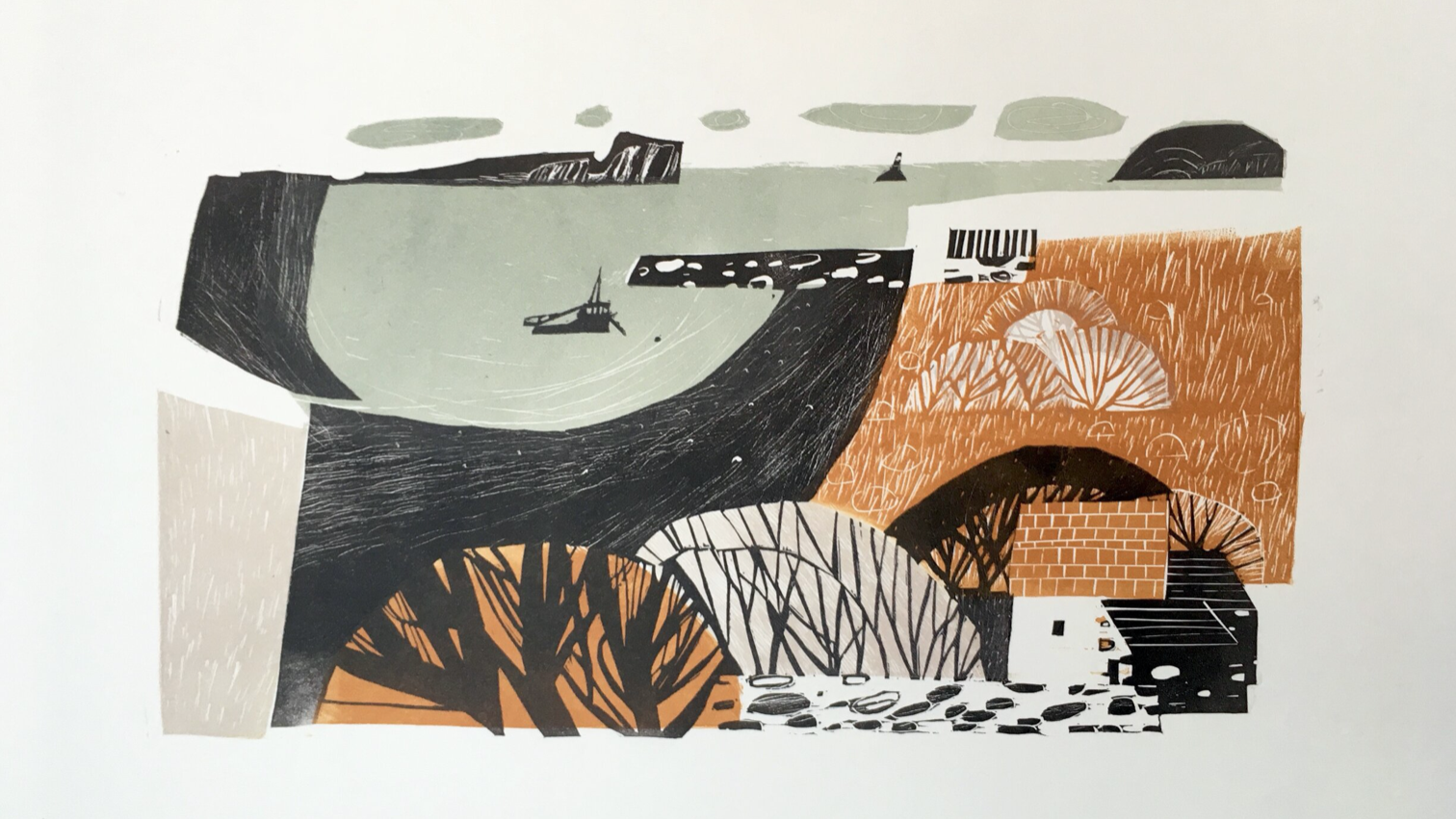
By Rory Flyn Art above by Philip Thomas
A gentle swish on the underside of the car, made by long grass growing between the tracks of the driveway. That is my earliest memory of Skye. Arriving in the dark at a white croft house in the south of the island, just off the main road and ten minutes’ drive from the ferry.
We came here often in summer for long, rambling holidays with our cousins, running outside on the hill, in the fields or on the beach at Ashaig. We visited my Gran in Portree with her six dogs, three of whom were called Cuillin. We went on the ferry just to get a bag of chips from Kyle. Once, we got to drive a Fergie around the field opposite, sitting on the knee of a neighbouring crofter. Long, glorious summers, with only the midges to irritate us.
My mother and her four siblings grew up on Skye, and her father’s family were originally from Breakish. My great-grandfather was a tailor with a workshop in Kyleakin, and his croft house was still held by my uncle and used by members of the family when they returned to visit. After my grandparents died, we had no immediate family left on Skye. When the croft house was eventually sold, my uncle’s tenancy of three acres of unkempt croft land became the final thread keeping us connected to the island.
I met Neil and Alasdair Stephen at architecture school in Aberdeen. They had just started Dualchas Building Design on Skye and I had just begun my studies. They talked passionately about the beautiful landscapes of the Hebrides and the poor buildings that had proliferated there over the previous three decades. Straight from university, they had boldly started building houses for friends and acquaintances, working with modest budgets supplemented by the rural housing grants available at the time.
After a while, Mary Arnold-Forster joined the practice and helped it develop, grow and refine. From afar, I followed this progress with interest, intrigued that it could be done on Skye. After a chance meeting shortly after our son was born, Mary asked if I would be interested in coming to work with Dualchas. Having grown up in the Highlands, both my wife and I had always wanted to leave the city eventually and raise a family there. We considered it carefully and realised this was the chance we had been waiting for.
Over the last ten years we have been immersed in living, working and travelling throughout the Inner Hebrides. We have found the islands welcoming for a young family and, if you learn to be patient with the geography and weather, they can be places of calm and opportunity. They have been subtly changing over the last decade, partly through outward influence and partly through inward resilience and optimism.
Skye is now connected to the mainland by our infamous bridge. This makes it the most easily accessible of the Hebrides and offers the convenience of getting on and off the island whenever you want, unhindered by the vagaries of the ferry network.
In the last decade, those who rely on it have experienced a marked decline in the reliability of the Caledonian MacBrayne service. The ferries are a lifeline for the Hebrides, but with the fleet operating with the minimum number of vessels, cancellations are commonplace, especially throughout winter. You can imagine how galling it is to see a CalMac advert for an idyllic summer beach experience when you have just been told that the only crossing on a flat-calm day has been cancelled and you have no option but to wait it out.
The bridge has also contributed to an unprecedented tourism boom. The effects are well documented and have resulted in key visitor destinations becoming overrun during the summer. Tourism has been a major industry on Skye for generations, with most people and places touched by it in some way. But it has taken too long for communities to be provided with the facilities and means to deal with the sudden influx of visitors arriving by car.
The fragile single-track roads synonymous with the Hebrides routinely become clogged with inappropriately sized campervans hired from the Central Belt, and it has taken many years for simple facilities such as car parks and toilets to be provided at some of the nation’s most visited natural attractions.
Sustainable tourism will be a key industry for Scotland in the coming years. We must do our utmost to protect the unique environment people come to experience, giving communities the means to provide and profit from the services required while dispersing visitors more evenly. To create a network of robust, high-quality facilities, we should look to international examples such as the Norwegian Scenic Routes. The need for a rural tourism development body to coordinate these efforts is long overdue.
Repopulating the islands has been a stated ambition of governments and councils for decades, but despite varying levels of effort and innovation, there has been little substantial progress in reversing gradual depopulation. We all want healthier, less fragile economies. We want our schools to have stability and hope for the future, and our businesses to be staffed and supported.
Repopulation should be a little easier in the Inner Hebrides than in other island groups, given our proximity to the mainland and the variety of landscapes and communities they offer.
With flexible working methods and patterns becoming more prevalent following the pandemic, our hope is that people will feel increasingly able to put greater emphasis on where they want to live, rather than where they previously felt they had to be. This can already be seen in the numerous small, often craft-based businesses established here over the last decade, many using a strong Hebridean identity to their advantage.
Scottish islands are consistently identified among the happiest places to live in the UK. If we can provide houses to live in and reliable ways to travel, there are opportunities for the islands to attract more working people to make a home for themselves in the Hebrides.
Working
Architecture gives you the opportunity to work intensely in a place, and the responsibility to create something of lasting functional and cultural value. We feel fortunate to have these islands as our place of work.
Moving between the Inner Hebrides also gives you the opportunity to appreciate their distinct geographical and cultural personalities. Arriving by sea allows you to experience an island fully in its context. It has an edge and it has an interior.
Each of the islands is distinctive: Skye is large and mountainous, with peninsulas of varying character; Mull is indented by bays and sea lochs; Tiree is low-lying and sandy; Islay is fertile and defined in part by its famous whisky tradition. Over the years, we have had the chance to work on nearly every one.
A new project always requires an initial reading of the landscape and culture. There is a rich variety of building in the Hebrides: the network of brochs; planned villages; scattered but ordered crofting settlements; ruined and abandoned structures. Aerial photographs reveal the rich history of land use and ownership patterns: peat cuttings, clachans, fanks, tracks, plantations and harbours.
Historic buildings are often characterised by their essential, modest nature and simplicity of materials, born out of necessity.
Early discussions about projects often centre on the practicalities of building: who is available, good and eager, and how we can get labour and materials to the site. These considerations are important. There are limited options and difficult consequences if assumptions are ill-judged.
Reading the grain of a place, and recognising when to work with it and when to work against it, is a craft that takes time to develop and refine. The skills learned working in the Hebrides are transferable to other islands, and we have subsequently worked on projects in the Isles of Scilly, Jersey and Nantucket.
There is a small, discreet network of practices living and working in the Inner Hebrides, each with its own approach to creating a distinct architecture of place. It is a healthy and developing modern culture: Dualchas and Rural Design on Skye, Roots on Tiree, Thorne Wyness on Mull and a few others. We work in parallel, passing like ships in the night, or ferries in the bay.
It would be desirable for the Inner Hebrides to have stronger connections with one another, rather than primarily with the mainland. A coastal boat service connecting the main towns of the Hebrides and West Coast could save thousands of mainland road miles and serve locals and visitors equally, without the need for cars.
Reviving an old steamer route between the ports of Wester Ross, Skye, Mull and Argyll as a functional daily express service could also help engender a sense of togetherness in the Inner Hebrides that is not felt as strongly as in the more interconnected Western Isles, Orkney and Shetland. Its popularity, I suspect, would be assured.
Last summer, from the rear of a returning ferry at the end of a long, sunny site trip, we watched an incredible red sunset to the west over the Outer Hebrides. Half an hour later, back on Skye, we experienced an equally magnificent luminous moonrise over the Inner Hebrides. As part of a working day, that experience is memorable and hard to beat.
Housing
We live and work in a landscape that is sometimes harsh, sometimes peaceful, but always inspiring. We make buildings on the edges of lochs, in quiet glens, amongst birch woods and on rock. These buildings look out over beaches, sea and mountains. And we get to travel on roads and ferries that visitors from around the world come here to experience.
But within this landscape there is a crisis that continually threatens its communities and their attempts to grow and develop in the twenty-first century. It is a housing crisis.
The lack of housing, and affordable housing in particular, is a problem common to almost every part of the British Isles, but in rural areas on the periphery the sense of anxiety is heightened. There are many contributing factors to the island housing crisis: the expense of building in rural areas; low wages; poor-quality existing housing stock; limited options for people wishing to relocate; and a historic lack of investment in housing association projects.
We only have to look around us to see the symptoms: homeless colleagues, families living in inappropriate accommodation and local businesses unable to house potential staff.
Communities cannot grow if there is nowhere for people to live. Young people leave. School numbers drop. Confidence deteriorates.
One of the major factors affecting new housebuilding is the lack of available land. Land ownership is a historically sensitive issue, particularly in the Highlands, where the effects of the Clearances of the nineteenth century can still be seen everywhere: in ruined villages and in a population that remains substantially below its nineteenth-century peak.
Large estates own much of rural Scotland. Concentrating ownership of the land in relatively few hands inevitably affects the ability of communities to access land and grow.
Being an area with a successful tourism industry also means that competition for houses and building sites can be intense. Higher house prices elsewhere can make it difficult for local people to compete in an open market. Long-term rental is also challenging, as properties previously available to local tenants have increasingly been used as short-term holiday accommodation.
Some of the solutions to these social and economic issues are political, and there has been notable progress in the number of housing association homes being built. Here on Skye, after many years of trying, Dualchas secured a commission for 16 housing association houses, while numerous other developments by local architects were also in development or on site when this article was first written.
Housing associations can also provide routes for people on low to modest incomes to own their own homes through shared ownership or equity, alongside serviced plots within new housing developments. A good start.
Architects, as agents of change, also have a responsibility to address the social and economic problems within their communities.
We work on the projects we are asked to do and chase those we aspire to. But how do we square working on private, bespoke houses for relatively well-off clients with the affordable housing crisis we experience around us?
Not everyone is eligible for housing association schemes, and there are also people who want to build on land acquired through family connections. Housebuilding is an expensive and challenging undertaking in our area. But for people and families looking to settle in a particular place, and who have access to land, it is often the only realistic option. The process of procuring a new house has to be simpler.
Our experience led us to establish a separate kit-house company. HebHomes provides a series of pre-designed houses that we believe are appropriate to the landscape and building culture of the Highlands and Islands. Kit-house companies have traditionally tended to offer generic suburban models of living that can sit uncomfortably within the Highland landscape and climate.
The longhouse-inspired designs initially developed by Dualchas and now offered through HebHomes have been well received by planning authorities and included as examples in design guidance. They have also influenced other manufacturers and developers, helping to create a market for a more fitting and distinctive contemporary Hebridean architecture.
We identified a need to reduce the cost and risk involved in procuring a house and felt it was important to provide a single route through site analysis, professional advice, technical documentation and the statutory approvals required to build.
The houses range from modest structures to substantial family homes, and can be procured flexibly, from a kit of parts and drawings through to complete turnkey delivery. Clients, their families and friends often have skills, resources and abilities that can make construction more affordable. That flexibility allows clients to contribute sweat equity and enhance the value of their home.
Dualchas is also involved in encouraging estates and communities to develop masterplans for sites allocated for new housing. Without intervention, these sites can remain dormant, restricting the ability of communities to grow and limiting opportunities.
There is hope that community-led innovation can help deliver the specific outcomes rural communities need. Strontian Primary School in Sunart is one example: the community raised funds through community shares and grants to pay for a new school, with the foresight to design the building so that it could eventually be converted into affordable homes.
An architect friend once described how he takes on a limited number of loss-making community projects, often funded by profits from private house projects. He calls these his Robin Hood projects.
Our approach is different. Through HebHomes we have developed a framework for delivering homes for people with different means and ambitions. This has created jobs and opportunities for local companies and contractors and helped develop the housebuilding industry in the Highlands and Islands. It encourages building through simpler and more affordable access to architect-designed homes.
Our inspiring Highland landscape is not simply a backdrop to be viewed through fixed frameless glazing. It is home to living, breathing and sometimes fragile communities that require locally developed opportunities for growth.
As architects, we should remain conscious of the wider cultural environment within which we operate, and of our ability to shape it.
Home
There isn’t much I feel I need
A solid soul and the blood I bleed
But with a little girl, and by my spouse
I only want a proper house
My Girls, Animal Collective, 2009
When we were given the opportunity to take on the tenancy of the long-held but much-neglected family croft on Skye, it was a chance to put down roots and create a home. It was also an opportunity to experience first-hand the reality of the building process on the island.
Half of Eleven is a new self-build house for our young family and forms the first part of the regeneration of the land.
The design is low-lying and modest in scale, partly to sit unobtrusively within the coastal township of Breakish and partly to make it straightforward to construct by self-builders working with a limited budget.
The principal living space is glazed on two sides, taking advantage of views up the Inner Sound to the front while opening onto a sunny courtyard to the rear. The main building contains the living spaces and bedrooms, with views to the north. A lower perpendicular block containing the entrance, utility and guest bedroom separates a functional parking courtyard from a more intimate, planted south-facing courtyard.
Vertical untreated larch cladding allows the building to settle naturally into its relatively exposed surroundings. Hit-and-miss timber screening to the front provides shelter to recessed windows and external circulation.
Internally, exposed timber beams create a textured ceiling, adding height, concealing lighting and expressing the primary structure. The open living areas are divided by oak-ply dressers and a kitchen island, all set on a polished screed floor that runs throughout.
Ten years of experience of landscape, buildings and construction in the Hebrides informed the design and helped write a hopeful new chapter in the history of the croft.
Originally written for the Spring 2022 Islands edition of the RIAS Quarterly.